
A bowing basement wall is one of the clearest indicators that a foundation is under stress. While cracks often draw the most attention, the bowing itself is the real problem. Cracks are simply the visible symptom of a wall that is bending inward under pressure.
Understanding why basement walls bow, how cracks relate to that movement, and what it takes to stop it can help homeowners act before damage becomes severe or irreversible.
Straight Answers First (Q&A)
Q: What does it mean when a basement wall is bowing?
It means the wall is bending inward due to lateral pressure from soil, water, or expansive conditions outside the foundation.
Q: Are cracks always present with bowing walls?
Often yes. Horizontal or stair-step cracks commonly form as the wall bends.
Q: Can a bowing wall collapse?
In extreme cases, yes. Most walls show warning signs long before failure, which is why early stabilization is critical.
Why Basement Walls Bow
Basement walls are designed to support vertical loads from the home above — not continuous horizontal pressure from the surrounding soil.
The most common causes include:
1. Hydrostatic Pressure
When soil becomes saturated, it presses inward with significant force. Poor drainage allows this pressure to remain constant rather than temporary.
2. Expansive Clay Soils
Clay expands as it absorbs moisture and shrinks when dry. This repeated cycle pushes and pulls against the foundation wall year after year.
3. Freeze–Thaw Cycles
Frozen soil expands outward, increasing seasonal pressure against basement walls.
4. Improper Drainage
Short downspouts, clogged gutters, and negative grading concentrate water at the foundation, dramatically increasing lateral load.
5. Weak Foundation Materials
Concrete block walls are more susceptible to bowing because mortar joints are weaker than poured concrete.
How Bowing Walls and Foundation Cracks Are Connected

- Tensile stress builds on the inside face of the wall
- Cracks form where stress is highest
- Mortar joints separate (block walls)
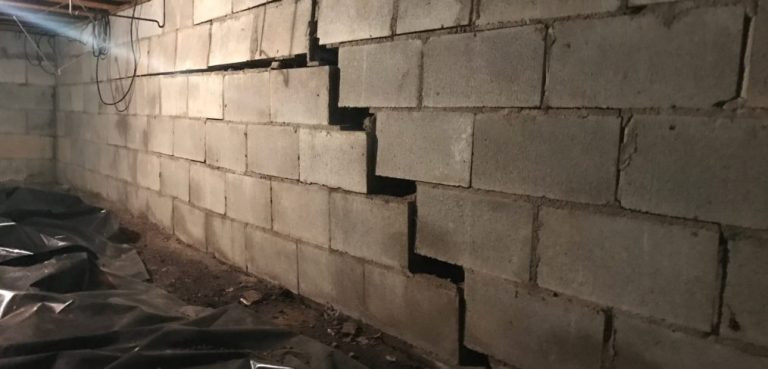
- Horizontal cracks often appear near mid-wall height
Cracks are evidence of stress, not the root cause.
Common Crack Patterns Seen With Bowing Walls
Horizontal Cracks
Typically appear near the center of the wall where bending stress is greatest. These are often structural.
Stair-Step Cracks
Common in block foundations, following mortar joints as the wall shifts.
Multiple Cracks
When pressure is ongoing, multiple cracks can form across the same wall.
How to Tell if a Bowing Wall Is Getting Worse
Warning signs that movement is progressing include:
- Increasing inward bulge
- Widening cracks
- New cracks forming
- Walls pulling away from floor joists
- Doors or windows above sticking
- Visible separation at the top of the wall
Monitoring is helpful, but movement usually does not reverse on its own.
Why Bowing Walls Should Not Be Ignored
- Cracks continue to grow
- Structural capacity decreases
- Repairs become more invasive
- Replacement may eventually be required
Early stabilization often preserves repair options that disappear once bowing becomes severe.
How Bowing Basement Walls Are Stabilized
Step 1: Reduce Exterior Pressure
- Improve surface drainage
- Extend downspouts
- Correct grading
- Address water management issues
Pressure reduction helps, but it does not reverse existing movement.
Step 2: Install Structural Reinforcement
Common stabilization options include:
Carbon Fiber Reinforcement
- Low-profile
- Interior installation
- Effective for early-to-moderate bowing
- Preserves basement space
Steel Beam Systems
- Provide strong resistance
- Used for more advanced bowing
- Reduce usable wall space
Wall Anchors
- Require exterior excavation
- Transfer pressure to stable soil
- Can allow gradual correction
Can Bowing Walls Be Straightened?
Some systems allow partial correction over time, but many stabilization methods focus on stopping further movement rather than full reversal. Preventing progression is often the primary goal.
People Also Ask
Is a bowing basement wall dangerous?
It can be if movement continues unchecked. Early stabilization greatly reduces risk.
How much bowing is too much?
There is no single threshold. Even small deflection combined with cracking warrants evaluation.
Can drainage alone fix a bowing wall?
Drainage helps reduce pressure but usually cannot reverse existing structural damage.
FAQ: Bowing Basement Walls
Do all bowing walls need stabilization?
Most do. The degree and method depend on severity and wall condition.
Can bowing walls be fixed from the inside?
Yes. Many modern systems are designed for interior installation.
Will stabilization stop new cracks from forming?
When pressure is controlled and the wall is reinforced, new pressure-related cracks are far less likely.
Final Thought
Bowing basement walls are a structural issue, not a cosmetic one. Cracks are simply the visible signal that pressure is winning. The right stabilization strategy stops movement, preserves structural integrity, and prevents far more costly repairs down the road.