Facts About Detroit
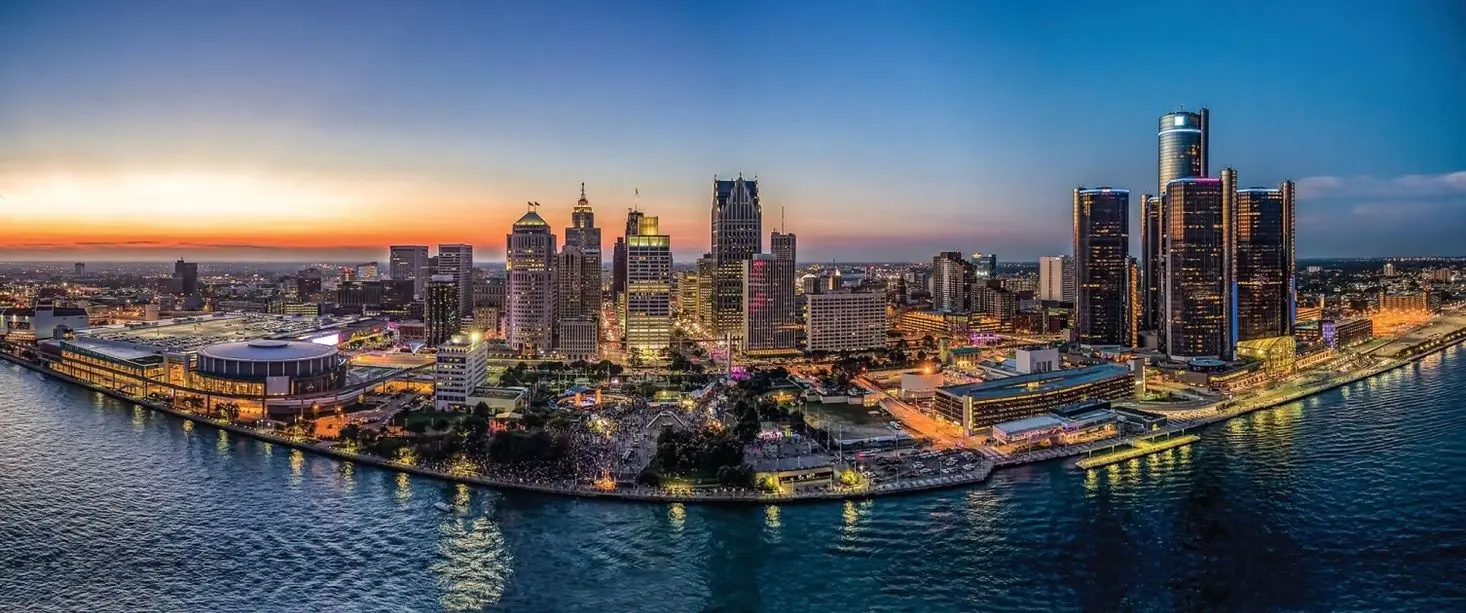
Antoine Laumet de la mothe Cadillac, a French military leader and trader, had traveled widely in New France and the western Great Lakes. In 1698, Cadillac returned to France to petition King Louis XIV to authorize him to establish a French outpost along “le Detroit” (The Strait), the waterway connecting Lakes Erie and Huron. Cadillac successfully persuaded the King’s Minister of Marine, Jerome Phelypeaux Comte de Pontchartrain, to authorize an expedition to establish a post.On June 5, 1701, two months prior to “The Great Peace of Montreal,” Cadillac’s expedition set out from La Chine, on the St. Lawrence River near Montreal. The expedition followed the northern route along the Ottawa River, Lake Nipissing, French River, Georgian Bay, Lake Huron, the St. Clair River, Lake St. Clair and, finally, the Detroit River. The expedition camped on Grosse Ile on July 23rd. Throughout the next 60 years, Detroit would remain a small frontier settlement. The entire village, including the stockade, streets and buildings, occupied an area of only one city block – bordered by the present-day streets of Griswold, Fort, Shelby and Larned. The early settlers included soldiers, artisans, trappers, hunters, farmers and traders. The economy was centered on the fur trade and farming. Native Americans were encouraged to settle around the village for mutual protection and to facilitate the fur trade. Since the 1950s, Detroit has blossomed as a metropolitan area. While the population of the city proper has dropped from close to 2 million to less than 1 million, the metro area boasts more than four million residents. Many homes and jobs have cropped up in the surrounding suburbs, and the city itself is experiencing something of a renaissance. Many young professionals have flocked to Detroit in the last 15 years, bringing with them new enterprise and a breath of fresh air. Detroit will always be Motown or Motor City, but the town’s industry is shifting in favor of technology. Compuware, a software company that’s made a name for itself in the information technology field, established their headquarters in downtown Detroit in 2004, bringing 4,000 employees with them. The Detroit art scene has seen a huge revitalization as well. Many landmarks like Fox Theater and the Detroit Opera House have been renovated and now host concerts, plays, and other performances. The Detroit Institute of Arts completed a massive expansion effort in 2007, and has one of the most important art collections in the country. Some people think of Detroit as a dying city, but that couldn’t be farther from the truth. Detroit isn’t the city that it was 60 years ago, sure, but in no way does that mean the city won’t last. Detroit is evolving into something greater. It’s home to business, art, and innovation, and it’s very much alive.
Carbon Fiber Foundation Crack Repair
Carbon fiber is made through a complex process involving high heat that rearranges molecules. It also requires sophisticated equipment. For years, carbon fiber was just too expensive to produce to be viable for anything but the most critical applications, like space shuttles, airplane wings, and repairs of bridges and commercial concrete structures. But more recently, more reasonable production costs and its incredible strength have opened the door to a host of new applications – and we’re seeing more and more carbon fiber-based products in hundreds of everyday uses. StablWall is designed around the same concepts used in heavy industrial settings – the sheets are wider, and cover more area than other carbon fiber products on the market today – the benefit to you is more coverage and better strength! StablWall uses technology to help you feel confident about the strength of your foundation, StablWall uses carbon fiber technology to strengthen basement walls and concrete structures. For the first time, homeowners and residential contractors can benefit from carbon fiber’s strength – until recently, carbon fiber was only available to commercial or government contractors. StablWall consists of carbon fiber sheets. Those sheets consist of thousands of strands linked together and running in the same direction. When those sheets are bonded to a concrete structure, they add tremendous strength to that structure. The StablWall System also consists of specially engineered epoxies that bond the carbon fibers to a concrete wall or structure. Once bonded, the wall becomes significantly stronger than it was before – thereby eliminating the worry of additional cracking or bowing. Better yet, the StablWall system does not detract from the look or amount of space you have to work with. Contact StablWall Today! 866.782.5955