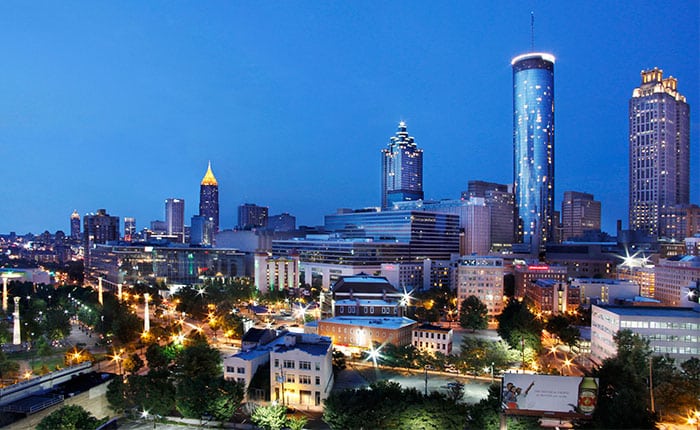
Facts About Atlanta
The history of Atlanta dates back to 1836, when Georgia decided to build a railroad to the U.S. Midwest and a location was chosen to be the line’s terminus. The stake marking the founding of “Terminus” was driven into the ground in 1837 (called the Zero Mile Post). In 1839, homes and a store were built there and the settlement grew. Between 1845 and 1854, rail lines arrived from four different directions, and the rapidly growing town quickly became the rail hub for the entire Southern United States. During the American Civil War, Atlanta, as a distribution hub, became the target of a major Union campaign, and in 1864, Union William Sherman’s troops set on fire and destroyed the city’s assets and buildings, save churches and hospitals. After the war, the population grew rapidly, as did manufacturing, while the city retained its role as a rail hub. Coca-Cola was launched here in 1886 and grew into an Atlanta-based world empire. Electric streetcars arrived in 1889, and the city added new “streetcar suburbs”.In 1996, Atlanta hosted the Summer Olympics, for which new facilities and infrastructure were built. Hometown airline Delta continued to grow, and by 1998-9, Atlanta’s airport was the busiest in the world. Since the mid-’90s, gentrification has given new life to many of the city’s in town neighborhoods. The first major mall built in Atlanta was Lenox Square in Buckhead, opening in August 1959. From 1964 until 1973, nine major malls opened, most at the Perimeter freeway: Cobb Center in 1963, Columbia Mall in 1964, North DeKalb and Greenbriar malls in 1965, South DeKalb Mall in 1968, Phipps Plaza (near Lenox Square) in 1969, Perimeter and Northlake malls in 1971, and Cumberland Mall in 1973. Downtown Atlanta became less and less a shopping destination for the area’s shoppers. Rich’s closed its flagship store downtown in 1991, leaving government offices the major presence in the South Downtown area around it. On the north side of Five Points, Downtown continued as the largest concentration of office space in Metro Atlanta, though it began to compete with Midtown, Buckhead, and the suburbs. The first four towers of Peachtree Center were built in 1965-1967, including the Hyatt Regency Atlanta, designed by John Portman, with its 22-story atrium. In total, 17 buildings of more than 15n floors were built in the 1960s. The center of gravity of Downtown Atlanta correspondingly moved north from the Five Points area towards Peachtree Center. Atlanta’s convention and hotel facilities also grew immensely. John C. Portman, Jr. designed and opened what is now the AmericasMart merchandise mart in 1958; the Sheraton Atlanta, the city’s first convention hotel, was built in the 1960s; the Atlanta Hilton opened in 1971; as did two Portman-designed hotels: the Peachtree Plaza Hotel now owned by Westin in 1976, and the Marriott in 1985. The Omni Coliseum opened in 1976, as did the Georgia World Congress Center (GWCC). The GWCC expanded multiple times in succeeding decades and helped make Atlanta one of the country’s top convention cities.
Carbon Fiber Foundation Crack Repair
Carbon fiber is made through a complex process involving high heat that rearranges molecules. It also requires sophisticated equipment. For years, carbon fiber was just too expensive to produce to be viable for anything but the most critical applications, like space shuttles, airplane wings, and repairs of bridges and commercial concrete structures. But more recently, more reasonable production costs and its incredible strength have opened the door to a host of new applications – and we’re seeing more and more carbon fiber-based products in hundreds of everyday uses. StablWall is designed around the same concepts used in heavy industrial settings – the sheets are wider, and cover more area than other carbon fiber products on the market today – the benefit to you is more coverage and better strength! StablWall uses technology to help you feel confident about the strength of your foundation, StablWall uses carbon fiber technology to strengthen basement walls and concrete structures. For the first time, homeowners and residential contractors can benefit from carbon fiber’s strength – until recently, carbon fiber was only available to commercial or government contractors. StablWall consists of carbon fiber sheets. Those sheets consist of thousands of strands linked together and running in the same direction. When those sheets are bonded to a concrete structure, they add tremendous strength to that structure. The StablWall System also consists of specially engineered epoxies that bond the carbon fibers to a concrete wall or structure. Once bonded, the wall becomes significantly stronger than it was before – thereby eliminating the worry of additional cracking or bowing. Better yet, the StablWall system does not detract from the look or amount of space you have to work with. Contact StablWall Today! 866.782.5955