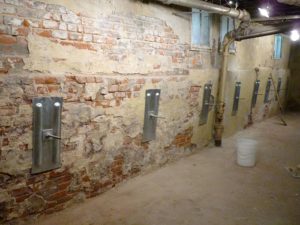
stablwall vs. wall anchors

StablWall vs. Wall Anchors

StablWall vs. Wall Anchors

Do you have a bowed foundation wall? You may be trying to decide what method of foundation repair to apply to it. You may be wondering which is better: StablWall vs Wall Anchors.

If you’ve done your research, you’ll know that the bowing of the foundation wall is caused by strong lateral forces acting on the outside of the wall. In many instances, these forces are the result of high hydrostatic pressure in the soil surrounding the foundation. The pressure against the wall causes the wall to shift inward.

Bracing or Reinforcing

In order to repair the foundation wall, you will not only have to find a way to relieve the pressure but also to counteract it. You can either brace the wall or reinforce it.

Wall anchors are used to brace the wall. They can be installed either inside or outside the foundation wall. There are different types of anchors. One popular type includes a wall plate that is bolted onto the bowing wall. The plate is held in place by a rod that is connected to another plate that is installed in the ground some distance away from the wall.

Reinforcing foundation walls is becoming more popular. Reinforcing walls may include using carbon fiber strips or sheets that are installed on the wall. These provide the wall with more strength to resist the pressure from the outside. StablWall is a carbon fiber system that can be bonded directly onto the wall. This makes the wall much stronger than it was before.

StablWall vs Wall Anchors

With a clear understanding of what each system does, it is much easier to make a decision. The following are some differences you may also like to consider when making your choice.

  1. Maintenance

StablWall does not require maintenance once it is installed. In order to be effective, wall anchors have to be adjusted every now and then (most commonly every month) by turning the screws.

  1. Ease of installation

StablWall is easy to install. It is non-invasive and does not require excavation. Wall anchors have to be installed into the ground. This calls for excavation. The use of specialized equipment means that the installation of wall anchors is more expensive, labor intensive and time consuming.

  1. Integration

Wall anchors are conspicuous. StablWall can be easily camouflaged by painting it over. The carbon fiber sheets do not occupy any floor space. Repairing your walls with StablWall will not reduce your home’s aesthetic value.

Contact us today for more information!

Bowed Basement Walls | Col, OH | StablWall

Techniques for Bowing Foundation Wall Repair

Bowing Foundation Wall Repair

When you see cracks forming on your foundation wall, the first thing you should do is to call the experts. Foundation cracks are often a sign of the need for foundation repair. This isn’t a unique problem. Foundations, like any other part of the home, need maintenance.

Why You Need a Pro

You may be wondering why you should spend money and time calling a professional for only a few cracks on the wall. You’re not alone. Many homeowners will either ignore or seek do-it-yourself solutions to the cracks in an attempt to avoid what they think would be an unnecessary expense.

The problem with this is that foundation cracks often indicate a problem with the foundation, which if not properly repaired is likely to become a structural problem for the entire home. There’s also the problem of water seepage. Even cracks that aren’t allowing water through at the moment are likely to start leaking over time. You’ll end up with a wet basement that will result in further problems including damage of property as well as the growth of mold.

Repairing a Bowing Foundation Wall

Foundation cracks are often the first thing you’ll notice when your foundation is in danger. They are one of the first signs of a bowing foundation wall. In this situation, even the strongest sealants will not protect your wall from further damage.

The bowing occurs as a result of high pressure from the soils surrounding the foundation wall. It is important to not only relieve this pressure but also to provide more support for the wall. The following are two popular ways of providing support for foundation walls.

  1. Re-bracing walls

This is one of the most popular methods of repairing bowing walls. Re-bracing the walls involves reinforcing the walls. The reinforcement may be in the form of carbon fiber strips or steel beams. This provides long term support to the wall ensuring that it will not shift under pressure from the outside.

  1. Anchors

Foundation anchors are installed in a bowing foundation wall to counteract the pressure that is exerted against the foundation wall. The anchors can be installed either on the inside or the outside of the foundation wall. They are installed under the foundation wall. Modern anchors can be installed in the earth without the need for excavation.

If you have bowing foundation walls, have a chat with a professional contractor about the different options available to you.

Bowing Cinder Block | Philidelphia, PA | StablWall

Invest in Professional Bowing Foundation Wall Systems

Bowing Foundation Wall

Have you spotted cracks on your foundation walls? Do your walls seem to be bulging inward? You may be dealing with a bowing foundation wall. While you may be tempted to ignore these signs, they are only bound to get worse. You’re not only endangering your family but also reducing the value of your home. According to the National Realtors Association (NRA), bowing foundation walls result in a 50% loss in home value at the least.

If it’s any consolation, this type of foundation problem is not uncommon. The Concrete Foundations Association’s (CFA) data shows that 59% of foundation repairs have to do with bowing walls. One of the major causes is unstable soils. Other causes include hydrostatic pressure and poor construction.

Professional Systems

The good news is that there are various contemporary solutions that professionals can provide you with. A professional inspection of your foundation must be carried out first. This ensures that the underlying cause of the bowing is determined. The contractor is therefore able to apply the right solution.

Some common contemporary solutions for a bowing foundation wall include:

  • Installation of carbon fiber sheets or strips

This is one of the most effective and easiest ways to repair bowing foundation walls. The carbon fiber offers 10 times the strength and resistance of steel beams. Installing these steel beams is easy and noninvasive. Work can be completed in a matter of hours.

  • Helical anchors

Helical anchors are used where damage is the result of instability. The anchors provide stability to foundation. These anchors are installed beneath the foundation where they offer the same stability as if the foundation was set on bedrock.

The installation process is minimally invasive. The anchors are sunk into the ground without causing a lot of disturbance to the surface of the soil. They are easy to conceal and offer a long term solution to bowing and instability.

  • Steel wall braces

These are designed to provide support to walls that are bowing inward. They consist of steel beams that are fitted onto walls. They can be tightened as time goes and are therefore a great choice for walls that have bowed extensively. They can be used to restore a bowing foundation wall back to its original position over time.

It is important to talk to your contractor and determine the best solution for your bowing foundation wall. Choose a solution that will provide you with long term benefits.

Time to Secure Your Biggest Investment by Understanding Foundation Wall Repair in Charlotte NC 28201

You have saved painstakingly for the last two decades and now you have a new home. One year down the line, when taking a proud inspection of your home, you notice cracks along the walls. After some research, you discover that you have an issue involving foundation wall repair in Charlotte NC 28201 and need some professional work done.

Speedy Resolution

While your reaction will definitely be panic, you need to try and relax, get insight on the problem and then use an expert contractor to sort the issue. Quite understandably the information you have gathered points to the gravity of the structural problem at hand and prompt action is called.

Foundation Cracks in Detail

Foundation cracks, according to experts, are caused by hydrostatic pressure caused by water pressing against these walls to a point of exceeding their capacity. This problem indicates a bigger underlying problem, which is the compromising of your home’s structural integrity.

Specific problems that precipitate these dangerous cracks include:

  • Heavy rains and inadequate grading leading to soil expansion around the foundation walls.
  • Expansive clays and frost can lead to wall fatigue leading to bowing under pressure.
  • Poor drainage, especially due to ineffective gutters and downspouts, leading to inadequate drainage of rain runoff makes the soils around the foundation heavier.

With increased lateral pressure caused by soil loads and other factors, the original capability of a foundation wall to resist is surpassed and the seemingly harmless cracks are just a step in a process that can eventually lead to caving in of your treasured jewel, your home.

Telltale Signs

Due to different structural designs, it might not be possible to notice a compromised foundation immediately. However, you should look out for other alarm bells including:

  • Walls leaning in at the top which is direct effect of bowing at the foundation.
  • Stair-step and horizontal cracks caused by excessive lateral pressure, which the foundation wall cannot handle.
  • Diagonal cracks at the corner positions.
  • Bulging along foundation walls at the bottom.
  • Furniture not sitting flush with the walls and paintings not hanging properly.

Capitalizing On Professional Expertise in Foundation Wall Repair in Charlotte NC 28201

Now that you understand what is behind your foundation problems, it is time to get working and get it sorted promptly. For starters, you need to appreciate that specialized skills and equipment in foundation wall repair are required to diagnose and correct the underlying issues. Extensive excavation is also involved before temporary supports are put in place as the wall is rebuilt. Some of the supports used include steel beam reinforcements, carbon fiber strips installations through the walls, use of sealants such as epoxy, and foundations wall anchors.

Your contractor will determine the extent of damage before deciding the reinforcement to apply. Remember, ignoring these minor cracks is courting disaster.

What Basement Wall Cracks Mean

Have you noticed cracks on the walls of your basement? Basement walls are under considerable pressure from the soil that surrounds them. The soil is constantly pushing against the exterior of the basement wall. The appearance of basement wall cracks is therefore often the first sign that there is a structural problem with the home.

However, there are different types of cracks that appear on basement walls. The appearance of the cracks tells a lot about what the problem is and how serious it is. Understanding the different cracks will help you determine whether your basement walls need immediate attention or not.

  • Horizontal cracks

Basement walls that are constructed without adequate vertical reinforcement succumb to the pressure of the soil around them. The walls tend to bow inwards and develop a horizontal crack that runs in the middle of the wall. The middle of the wall is the point at which the wall feels the highest pressure. This is why the crack forms at this point.

It is important to check if the wall is straight from top to bottom (i.e. plumb). If the wall is plumb, then you can wait to see if the crack will become any larger. If the wall is not plumb, contact a contractor as soon as possible.

  • Vertical cracks

Shrinking of concrete during curing is a normal occurrence. Any cracks that occur from this process are usually very small. They can’t normally be spotted. These cracks are usually negligible. They don’t affect the structure of the wall.

However, these small cracks can allow moisture in from the surrounding soil. It is therefore important to ensure that you contact a basement waterproofing contractor to check on the water proofing of your basement. This is especially important if you notice moisture on the basement walls.

Hairline vertical basement wall cracks that are only 1/16 inches wide shouldn’t be a cause for concern. Vertical cracks that are more prominent i.e. more than 1/8 inches wide should be a cause for concern. They are usually a sign that the wall is under great distress. A professional contractor should be contacted immediately to examine and repair the damage.

There are no quick fixes for cracks in basement walls. It is important to ensure that you contact a professional contractor as soon as you notice any cracks in your basement walls. This will ensure that your foundation walls are secure.

The A to Z of Dealing with Foundation Wall Cracks in Cincinnati OH 45201

When you move into your new house, the feeling is so exhilarating that no doomsayer would put a damper into your mood. However, you might be surprised to discover foundation wall cracks in Cincinnati OH 45201 a few months down the line just as you are getting used to living comfortably. Should this cause you nightmares?

maine payday loan

No Need for Sleepless Nights

Well, the answer is yes and no because such cracks are a pointer to structural issues with your foundation. At the same time, you should not spend sleepless nights thinking your home will come down any moment. Instead, you need to enlighten yourself on what these cracks are all about and take action to resolve the problem.

Causes of Wall Cracks in Your Foundation

Before you start scrambling and looking for DIY tips to repair wall cracks, you need to appreciate probable underlying problems. Some of these culprits include:

  • Improper concrete mixing: This leads to high water content in the mixture and when your house settles, the foundation fails to sustain the stress and cracks appear.
  • Poor drainage: This is the major cause of foundation cracks and it is also the most common. This moisture problem arises if there’s water seeping from rain or ground flow, humid air condensing in the basement or remnant water after construction.
  • Surrounding soil problems: Expansive clay and compressible soils are common in most modern building sites. Moreover, poorly compacted fill soil can lead to poor support thus causing foundation wall cracks.

Other common causes include plumbing leaks, premature removal of concrete forms, and rapid curing of concrete due to poor care or weather conditions.

Main Foundation Wall Cracks in Cincinnati OH 45201

There are three basic types of cracks and understanding them makes it easier for you to appreciate the problem your foundation is facing. These include:

  • Vertical foundation cracks: These are not structural in nature but are rather indicative of moisture problem around your foundation. Shrinkage of the foundation causes this problem and with the danger that moisture poses to your house, you should immediately contact a reliable contractor.
  • Horizontal foundation wall cracks in Cincinnati OH 45201: They are indicative of a wall that is under insurmountable lateral pressure. If a solution to ease load pressure is not effected immediately, your foundation wall will cave in and with it your precious lifetime investment.
  • Step cracks: They are an indicator of a settling foundation. While they don’t pose grave danger, they should be repaired promptly. As they say, a stitch in time saves nine.

The construction industry now has advanced technological solutions to foundation wall cracks in Cincinnati OH 45201. These include wall anchors, slab jacking, piering, polyurethane injection and a combination of carbon-fiber Kevlar grid straps and epoxies, among others.

Now DIY repair for foundation wall cracks in Cincinnati OH 45201 might sound easy, but don’t be fooled. Only an expert contractor can guarantee quality, reliable and durable workmanship for your property.

Carbon Fiber Wall Repair – Is This the Best Solution for Foundation Repair?

Advances in technology have also meant great advances and changes in many other fields. This includes construction. The construction industry has experienced changes in methods as well as the materials used for construction. Changes in materials used in the construction industry include the introduction of asphalt shingles which have overtaken wood shakes; the widespread use of drywall and the use of vinyl siding as a replacement for wooden clapboards.

Carbon fiber for foundations

The repair of foundation walls requires a strong material. Foundation walls are always under high pressure. The pressure on walls that are bowed, rotated or bulged is even greater because of the lateral pressure exerted on them by the expanding soil that surrounds it.

In the past, the standard way to repair foundation walls was to use steel I-beams. These were set vertically against the inside surface of the wall. The top and bottom of the I-beams were anchored to prevent any movement. This method of foundation repair is still being used even today. However, the use of carbon fiber strips is quickly becoming the most common method of foundation repair.

Carbon fiber wall repair

Carbon fiber is called thus because it consists of thin strips of carbon. These thin strips are woven into a fabric to form strips. When in this form, carbon fiber becomes virtually unbreakable. It does not stretch and is very strong. Despite its incredible strength, carbon fiber maintains a light weight. In fact, it is considered to weigh two thirds less than steel but is five times stronger.

Why professionals prefer carbon fiber wall repair

Many professionals are shifting to the use of carbon fiber for foundation wall repair. There are many benefits to using this material. These include:

  1. Installation of carbon fiber strips is quick and easy

The installation of carbon fiber is quite simple. It doesn’t take a high level of skill to do it. The installation process also doesn’t require many tools or materials. Installation of carbon fiber strips can be done within a few hours depending on the extent of damage to the foundation walls. You therefore won’t have to put up with many days of contractors trudging all over your home.

  1. Carbon fiber is incredibly strong

The construction industry has benefited a great deal from the introduction of carbon fiber. Carbon fiber is five times as strong as steel. It is however less than a third the weight of the same volume of steel. It is for this reason it is used widely in the construction of commercial aircrafts. This strength makes carbon fiber the best material to use in the repair of a foundation.

  1. There is no need for maintenance

Once the carbon fiber strip has been applied to the wall, there is no need for further maintenance. You therefore don’t have to worry about the extra costs that come with the maintenance and repair over time. Carbon fiber is durable too. You therefore won’t have to keep checking to ensure that the fiber is still in working condition.

  1. Low costs

If you want to save money on the repair of your foundation, then you should invest in carbon fiber strips. These strips are a cost efficient. They cost about half as much as you would spend if you were to invest in steel beams.

  1. Low visibility

If you want a solution that doesn’t stand out grotesquely, then carbon fiber strips are right for you. Once they have been installed they will appear as a small bump in the wall. You can paint over them if you want them to disappear completely.

What You Should Know About Carbon Fiber Wall Repair

carbon-fiber-wall-repairIf asked to describe carbon fiber in one sentence, it would be that it is a thin, lightweight yet strong material. The material is actually stronger than steel but very light in weight making it the perfect choice for applications that require strong and lightweight materials such as in the repair of residential foundations.

The following are some great facts about carbon fiber wall repair:

It can be used as an alternative to using heavy steel beams

Before the introduction of carbon fiber to the residential construction and repair industry, bowed walls were repaired using steel beams. The beams brace the walls from the inside. However, these beams can be an eye sore. Carbon fiber is suitable suit for the same application. Unlike steel beams, you can apply paint over carbon fiber to make it look like the rest of the wall. Concealing steel beams is much harder.

The most common application for carbon fiber in construction repair is for bowing block walls

You can use carbon fiber on the inside of the bowing wall of a basement. In this way, it acts as a brace to the wall and prevents it from bowing any further. This is as a result of the incredible strength of carbon fiber.

It needs to be linked to the house framing

For the structure of the house to be sound, contractors must fix the carbon fiber into the house framing. This will ensure that the carbon fiber system is stable and the wall will not cause it to move.

It has limits

Like any other material, carbon fiber has its limits. Contractors should therefore not treat it as the magical cure to all foundational problems. They can use it to repair walls that have moved up to two inches. Basement walls that have moved more than two inches may require more specialized repair.

Don’t attempt to DIY

Carbon fiber is a great and simple material to use for repairing your walls. However, its design was not for do-it-yourself projects. It requires the knowledge of an expert trained in foundation repair to understand how best to apply it. The professional can determine the integrity of the house structure and determine if carbon fiber is the best option for the situation.

Carbon fiber straps

These straps are applicable for repairing minor cracks in walls. They however are best for repair of block foundation walls or concrete walls.

Are you having problems with your foundation? Be sure to talk to a professional and discuss your needs. Carbon fiber wall repair could be the answer to your problem.

5 Things You Should Know About Carbon Fiber Wall Repair

carbon-fiber-wall-repairCarbon fiber is a man-made material that is ultra-light weight, thin, and stronger than steel . For years it has been used in many different industries and for various applications. In the past decade, it has made its way into residential foundation repair and become a popular choice. Here are the top five things you need to know about Carbon Fiber Wall Repair. 

Carbon fiber is best used for bowing block walls

Because of the nature of carbon fiber one of the most common applications in foundation repair is repairing a bulged or bowing block wall due to lateral pressure on the outside of a foundation wall. Carbon Fiber is installed on the inside wall of the basement to brace the wall and prevent it from moving anymore.

Carbon fiber is an alternative to steel I-beams

The old way to fix a bowing wall is with steel I-beams. Carbon fiber wall repair ultimately does the same thing as the Steel I-Beam system bracing the wall from the inside. The main difference is the final visual appeal. Carbon fiber can be painted over and made to look just like a regular wall. Although it can be done, the steel I-beams are a little harder to conceal.

Carbon fiber must be tied into the house framing

The Carbon Fiber system should be tied to the house framing to make the system complete. The bracing needs to stabilize the foundation and link it to the house framing to the structure is sound.

Carbon fiber does have its limits

Carbon fiber is not a cure-all system and doesn’t work with every foundation problem. Carbon fiber is best used for bowing walls. However, carbon fiber wall repair systems can only be used on walls that have moved two-inches or less. In the world of foundation repair, two inches is a lot and most homeowners notice the foundation damage well before that.

Not intended for the DIY

Even though carbon fiber wall repair is a fairly simple process it is not intended for the do-it-yourself homeowner. It requires the expertise and knowledge of a trained professional. Foundation repair specialists are licensed and insured to work with foundations. Working with the structural integrity of a house or building there isn’t much room for error. It is better left to the professionals.

Why We Love Carbon Fiber Wall Repair (And You Should, Too!)

carbon fiberCarbon fiber is awesome. Foundation waterproofing contractors really do love carbon fiber because it gives us another option to fix moving cracks and bowed walls.

http://report.thaihotline.org/loans-till-payday-no-credit-checks

Carbon fiber is stronger than steel and ultra lightweight. To help you get an idea, carbon fiber is the same material used to build space shuttles and airplane wings (super strong and super lightweight.) It can’t break and the fibers don’t stretch. 

Before carbon fiber, foundation repair contractors used anchors or steel beams to repair bowing walls. That process was hard and intrusive and the end product wasn’t very pretty. Homeowner’s like carbon fiber because when it is done it doesn’t look like a 1980s middle school kid with headgear. You can actually just paint over the carbon fiber sheets and it looks like your basement again. It is a good option of foundation repair for people looking to convert the basement into living space. It is a lot easier to hide than steel I-beams and actually costs less (commonly half the cost of steel beams).

Carbon fiber is a man-made material. It is heated carbon resins to extreme temperatures and woven into a fabric sheet. The process used to be extremely expensive; however, in recent years manufacturers have developed more reasonable production costs and opened the door for many different everyday applications to bring carbon fiber to the masses.

Installing carbon fiber for a foundation wall repair is fairly simple. Applications depend on the specific problem; however, basically, contractors prep the area first making it completely flat and add a bed of high-strength epoxy. Then the carbon fiber is embedded into the epoxy under pressure and then bolted to the top. The carbon fiber needs to be bolted into the framing of the house to ensure that is tied to the structure.

It can also be used with Kevlar staples to secure concrete cracks. Kevlar is like carbon fiber but instead of a sheet it is turned into a liquid and formed into different shapes creating a rigid, extremely strong product. (Think Kevlar motorcycle helmets and bullet-proof vests.) The crack is filled with epoxy. The Kevlar staples are installed to further secure the crack and prevent it from moving. Then the carbon fiber strip is attached on top of that. This makes the structural cracks stop moving.

The weight, ease and simplicity of carbon fiber make it a breeze to work with and a breath of fresh air for homeowners. Once the carbon fiber is installed there is virtually no maintenance. With the nature of carbon fiber and its strength and durability, when the repairs are completed they are permanent. When it is done, it is done. Now, that is why we love carbon fiber and you should, too.